I unintentionally got my first intern in 2007.
I was a designer, freshly promoted from being a junior designer. The company I worked at brought on an intern, and no one seemed to be helping them.
So I stepped in. I had them shadow me for a bit each day and made myself as available as I could to when they got stuck.
That was the first time I was professionally “in charge” of someone.
Since then, I’ve directly managed hundreds more people in my roles as a director, an agency owner, and consultant as well as through my apprenticeship program and cohorts I’ve taught.
One obvious takeaway from this experience: everyone eventually messes up.
That’s fine! Everyone should be allowed to mess up!
But, I’ve learned as a manager that not all mess-ups are created equal. Some I tolerate—and even encourage!—more than others.
What started as gut instinct was eventually given language by leadership scholar Amy C. Edmondson in her excellent Harvard Business Review article, Strategies for Learning from Failure. She outlines a spectrum of reasons for failure:
Deviance: An individual chooses to violate a prescribed process or practice.
Inattention: An individual inadvertently deviates from specifications.
Lack of Ability: An individual doesn't have the skills, conditions, or training to execute a job.
Process Inadequacy: A competent individual adheres to a prescribed but faulty or incomplete process.
Task Challenge: An individual faces a task too difficult to be executed reliably every time.
Process Complexity: A process composed of many elements breaks down when it encounters novel interactions.
Uncertainty: A lack of clarity about future events causes people to take seemingly reasonable actions that produce undesired results.
Hypothesis Testing: An experiment conducted to prove that an idea or design will succeed fails.
Exploratory Testing: An experiment conducted to expand knowledge and investigate a possibility leads to an undesired result.
She maps these on a spectrum from “blameworthy” to “praiseworthy.”
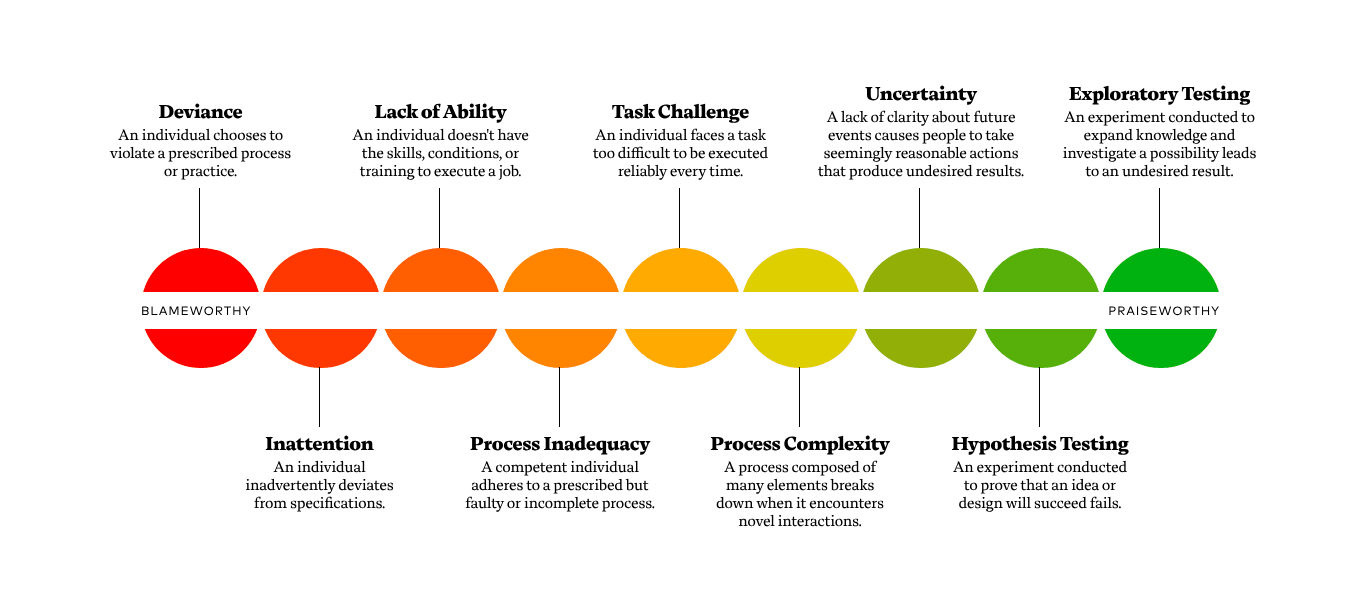
What a great rubric!
Now, when I work with someone—especially early in the relationship—I bring up this diagram and talk through it. I point out the kinds of failures I hope to see less of (blameworthy mess ups like inattention) and the kinds I don’t mind, expect, and even sometimes welcome (praiseworthy mess ups like hypothesis testing). I try to gently establish that an abundance of blameworthy failures will likely lead to some negative consequences while an abundance of praiseworthy “failures” might just get you compliments—or even a raise.
I’m a big believer that specific language and examples go a long way to helping any team see the future together.
read this next
A full line doesn’t always mean the right line.